

Overview
As regulatory demands like the EU Digital Product Passport (DPP) reshape the textile industry, fashion and textile traceability has evolved from a compliance requirement into an operational advantage. This article explores how brands, ELKA Rainwear, RAINS, Safiyaa, and Mason Pearson, leverage PSQR’s modular Saga platform. You can read how to centralize supply chain data, digitize factory-floor packing, protect global distribution channels, and meet sustainability mandates.
In the evolving fashion and textile landscape, brands operate at a complex crossroads.
On one side lies the operational reality of managing global, multi-tiered supply chains stretching across raw material suppliers, specialized manufacturing facilities, and diverse distribution networks. On the other side is a wave of unprecedented regulatory demands, led by the EU Digital Product Passport (DPP) framework and region-specific mandates like France’s AGEC law, alongside a growing consumer mandate for authenticity and sustainability.
For many fashion brands, answering basic questions, “Where was this garment made?” “Which Batch of fabric was used?” “Is this distributor selling into an unauthorized market?” requires days of manual spreadsheet auditing.
At PSQR, we have partnered with fashion, textile, and heritage craft brands to change that. By deploying our modular Saga traceability platform, industry leaders like ELKA Rainwear, Rains, Safiyaa and Mason Pearson have turned fragmented supply chain data into a unified operational asset.
Below, we examine how digital fashion and textile traceability addresses critical operational challenges, delivers measurable business value, and why implementing these systems is more achievable than ever.
1. Regulatory Compliance & Digital Product Passports (DPP)
Regulatory requirements are no longer a distant consideration. Instead, they are actively reshaping how textiles are packaged, labeled, and sold.
The European Union’s Ecodesign for Sustainable Products Regulation (ESPR) and national frameworks like France’s AGEC law demand complete transparency over product lifecycles, material provenance, and eco-credentials.
The Operational Challenge
Fragmented supplier data, reliance on disconnected manual databases, and manual label creation expose brands to severe operational and legal risks. Hence, inaccurate data creates delays at customs, inability to sell in key territories, or costly product relabeling campaigns.
How the Fashion and Textile Traceability Solution Solves It
PSQR’s Saga solution functions as a robust, EPCIS-based repository that consolidates product data into a single, centralized source of truth. Instead of managing static, disconnected files, brands can link raw material attributes, supplier certifications, and care instructions directly to unique product identifiers.
Real-World Brand Applications
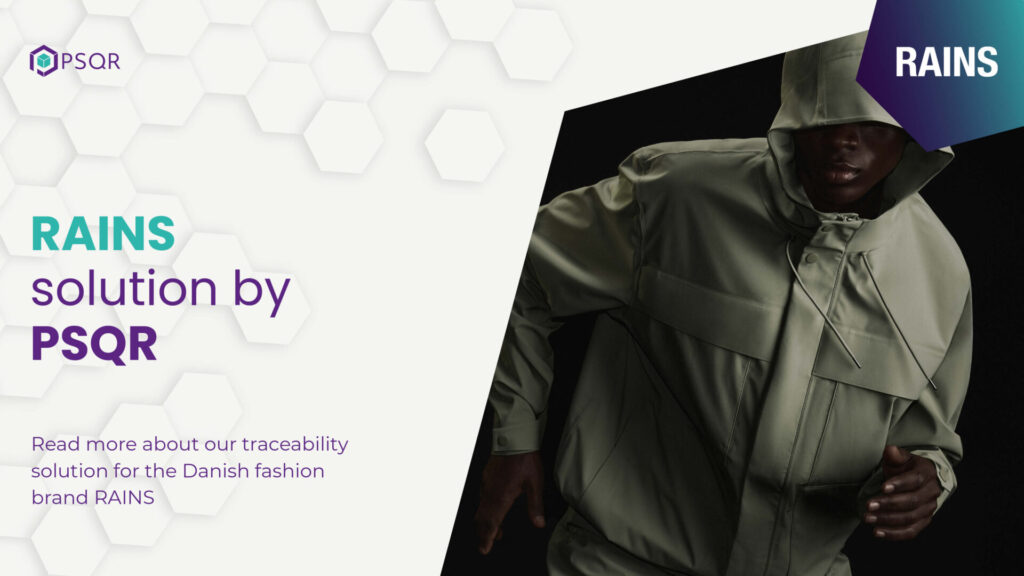
- RAINS: To maintain its agile global presence, Danish outerwear brand RAINS partnered with PSQR to streamline its product data architecture. By deploying dynamic QR-enabled labeling that complies with AGEC regulatory demands, RAINS established a centralized setup capable of handling complex compliance data at scale. As a result, their product lines are future-proofed against upcoming EU regulations.
- ELKA Rainwear: Renowned for their high-durability waterproof workwear, ELKA Rainwear modernized its operations by centralizing production data and automating label management. Through QR-enabled Digital Product Passports, ELKA gives customers and business partners instant, scannable access to care instructions, compliance documentation, and certifications right at the product level.
Click on the images to access the case studies:

2. Factory Floor Control & Production Intelligence
Operational efficiency is where companies win or lose on the factory floor. Whether managing bespoke high-fashion production or high-volume item assembly, visibility into daily floor activity is essential for controlling costs and maintaining quality.
The Operational Challenge
Paper-based tracking, manual logs, and disconnected inventory systems lead to high error rates, unrecorded material usage, and delayed order fulfilment. Without real-time visibility, management cannot identify operational bottlenecks until long after they have impacted margins.
How the Fashion and Textile Traceability Solution Solves It
By introducing handheld digitalization tools like Saga Mobile, brands can digitize manufacturing events as they happen. Frontline workers scan components at every stage of assembly, registering time, batch numbers, and quality metrics directly into the enterprise database.
Real-World Brand Applications
- Safiyaa: London-based high-end demi-couture brand Safiyaa required a standardized digital solution to manage inventory, streamline manufacturing across multiple production sites, and automate quality control. Implementing Saga enabled Safiyaa to track raw materials in real time, capture exact production timestamps, and digitize inventory workflows across facilities, achieving true operational clarity and better cost control.
- Mason Pearson: The iconic heritage hairbrush manufacturer faced operational friction in their packing and dispatch zones. By replacing manual paperwork with Saga Mobile, Mason Pearson gained instant control over factory floor workflows, dramatically cutting packing errors and building a reliable data foundation for their broader business.
Click on the images to access the case studies:


3. Brand Protection & Distribution Integrity
As brands scale internationally, maintaining control over where and how products are sold becomes a primary commercial priority. Gray-market diversions, parallel importing, and unauthorized discounting erode brand equity and damage key wholesale relationships.
The Operational Challenge
Once products leave the central warehouse, brands often lose line-of-sight into where items end up. Investigating market deviations traditionally meant manually cross-referencing shipping manifests, invoices, and serial numbers, a process so labor-intensive that most unauthorized activity went unchecked.
How the Fashion and Textile Traceability Solution Solves It
By deploying an enterprise-grade Saga Level 4 (L4) traceability instance, brands serialize products and aggregate event data across the entire distribution lifecycle. Every movement, from factory aggregation to regional distribution, is logged and searchable in real time.
Real-World Brand Applications
- Mason Pearson: Building on their initial success on the factory floor, Mason Pearson expanded their solution with PSQR to address global market integrity. Using a bespoke Saga L4 instance, what previously took hours of tedious spreadsheet reconciliation became a single-click audit.
As a result, Mason Pearson’s management team now gains instant, actionable intelligence to detect geographic deviations, protect brand value, and verify that products are sold in authorized markets at intended price points.
4. Key Features, Business Value, and Benefits
Adopting an enterprise traceability solution transforms compliance from an administrative cost center into a driver of operational efficiency:
| CAPABILITY / FEATURE | OPERATIONAL BENEFIT | STRATEGIC BUSINESS VALUE |
| Dynamic Serialization & Labeling | Automates data-to-label workflows across production lines. | Eliminates manual labeling errors and guarantees compliance with global DPP mandates. |
| Saga Mobile Integration | Empowers shop-floor workers to log events in real time using intuitive mobile apps. | Boosts packing accuracy, accelerates throughput, and eliminates paper tracking. |
| EPCIS-Based Data Repository | Standardizes data structure across suppliers, factories, and logistics partners. | Unifies fragmented supply chain silos into a single, searchable data hub. |
| L4 Analytics & Market Intelligence | Provides automated dashboards tracking serial numbers across distribution paths. | Identifies gray-market leakage, protects brand equity, and enforces channel control. |
| Dynamic Consumer Access (QR) | Connects end consumers directly to product origin and care data via simple scans, | Builds brand trust, improves customer engagement, and communicates sustainability values. |
5. Seamless Implementation: How Brands Can Get Started Fast
A common barrier to adopting new supply chain technology is the fear of long, disruptive software rollouts. PSQR designs software specifically to integrate into existing technical ecosystems with minimal friction.
Flexible, Phased Rollouts
Brands do not need to overhaul their entire infrastructure at once. As Mason Pearson’s two-phase evolution shows, companies can start small, addressing immediate operational pain points like shop-floor packing, and later layer on brand protection and customer-facing features as their digital maturity grows.
Zero-Downtime Data Migration
Transitioning from legacy databases or spreadsheets to an advanced repository does not mean pausing operations. During Mason Pearson’s Saga implementation, historical legacy data was fully migrated with zero operational downtime, ensuring continuous business activity throughout the upgrade.
Collaborative, Agile Methodology
Working alongside experienced implementation partners using an agile framework (as utilized during the RAINS deployment) ensures that software functionality closely mirrors existing workflows, driving fast internal adoption among factory floor operators and logistics managers alike.
Conclusion
Fashion and textile is no longer just a defensive compliance mechanism, it is a core operational capability that drives efficiency, protects market integrity, and deepens customer loyalty.
Whether your immediate priority is:
- satisfying EU Digital Product Passport requirements,
- standardizing multi-facility production, or
- stopping unauthorized distribution,
PSQR’s Saga provides the scalable architecture needed to transform your supply chain data into actionable intelligence.
Ready to modernize your operations and prepare your brand for upcoming regulatory standards? Contact the PSQR team today to discuss a tailored traceability strategy.