
SERVICES
Digital Product Passport (DPP)
PSQR offers a Digital Product Passport solution that transforms complex compliance requirements into a scalable solution tailored to your supply chain needs.

About the Digital Product Passport
A Digital Product Passport (DPP) is a standardized digital record that stores and shares key information about a product, including its origin, materials, sustainability, and compliance, throughout its lifecycle.
Mandated by the EU’s sustainability agenda, DPPs aim to improve transparency, circularity, and regulatory compliance across industries.
ABOUT DPP
Your Digital Product Passport Toolkit
Our modular platform supports the full product data lifecycle – from internal systems to public exposure.
Core feature include:
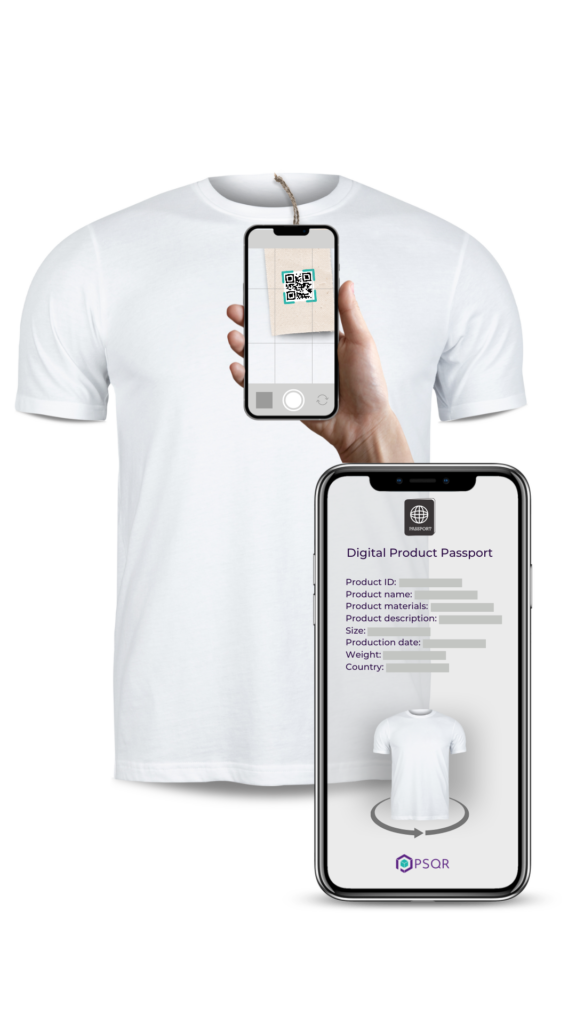
- QR code generation compliant with GS1 Digital Link
- Public product passport pages for end-user transparency
- Label serialization for care labels and hang tags
- Central data management for DPP-relevant attributes
- Support for EU Digital Product Passport and AGEC
- Seamless integration with ERP, PIM, and MES
- Smart validation and error prevention
Our solutions help manufacturers meet the DPP framework with confidence and speed.

INDUSTRIES
Industries affected by the Digital Product Passport
According to the European Commission, a number of industries and product categories will have to prepare for the Digital Product Passport regulation. With PSQR, you’re not just complying with the DPP Regulation, you’re gaining real-time traceability, customer trust, and operational agility.

Textiles

Batteries

Electronic devices

Construction materials

Plastics

Chemicals

Full EU Digital Product Passport Compliance
Under the European Union’s Green Deal and the Circular Economy initiative, companies working within industries, including apparel, batteries, consumer electronics, and others, will have to turn to a more resourceful and sustainable way of production.
As a result, all the products will have to have the following:
- Unique product identifier (UID)
- Product manufacturing information
- How to use information
- Recycling information
This information should be carried on an RFID or a QR code.
PSQR has developed a solution that allows customers to take full control of their product supply chain. This, in return, gives businesses the ability to have end-to-end traceability across the supply chain and provide data enabling transparency and visibility required by the new regulations. Moreover, our solution can assist companies in complying with the EU requirements for digital product passports.
USING SAGA
Why choose PSQR for Digital Product Passport Compliance?
Our Saga Software solution has been developed to cater to businesses’ unique needs.
Hence, whether you are looking for product digitisation in fashion, battery or other industries affected by the EU digital product passport, PSQR’s solution can be modelled to fit your specific case:
- Proven experience in DPP pilots
- Adaptable architecture for ESPR and European Commission DPP frameworks
- Fast implementation through agile delivery
- Centralized control of compliance data across global suppliers
- Future-proof foundation for circularity, repairability and transparency
BENEFITS OF USING SAGA
See how our solution works in practice
Some of the main benefits and advantages of working toward DPP through product traceability include the following:

AGEC & DPP
READINESS
We enabled factory-level care label serialization, each embedded with a scannable QR code linked to public AGEC data. The customer can manage product compliance data centrally and expose it transparently to end users.

OPERATIONAL EFFICIENCY & CONTROLS
By digitizing production time tracking, raw material inputs, and quality control, the brand gained real-time insights across manufacturing sites. Smart alerts prevent compliance gaps before dispatch.

SCALABLE COMPLIENCE INTEGRATION
We helped unify fragmented supplier and care label data. The solution automatically matches care label templates, generates QR labels, and publishes DPP-compliant pages for customers and authorities.