


The EU Battery Regulation (2023/1542) is reshaping how batteries are made, sold, and documented across Europe. While its scope is broad, covering everything from recycling targets to digital passports, its carbon footprint requirements under Article 7 are among the most technically demanding obligations the regulation introduces.
For manufacturers, importers, and distributors of batteries, understanding exactly what is required, and when, is no longer optional.
Who does this affect?
The regulation applies to all batteries placed on the EU market, regardless of origin. Therefore, there are no exceptions based on where the battery is manufactured. For instance, a company in Asia supplying EV batteries to a European OEM faces the same obligations as a European gigafactory.
Moreover, Article 7 carbon footprint requirements specifically target three battery categories:
- Electric vehicle (EV) batteries: powering cars, buses, and heavy transport
- Rechargeable industrial batteries with a capacity exceeding 2kWh: including energy storage systems and large industrial equipment
- Light means of transport (LMT) batteries: e-bikes, e-scooters, and similar vehicles
Portable batteries (under 5kg, used in consumer electronics) and SLI batteries (Starting, Lighting, Ignition) are currently out of scope for carbon footprint declaration requirements. Nonetheless, the Commission is required to assess extending coverage to portable batteries by 31 December 2030.
The phased deadline structure
The regulation rolls out carbon footprint obligations in three distinct waves, each building in complexity:
Phase 1: Declaration
Companies must calculate and declare the carbon footprint for each battery model per manufacturing plant, expressed in kg CO2 equivalent per kWh of total energy provided over the battery’s expected service life.
Phase 2: Performance classes
Batteries will be graded into performance classes (similar to energy efficiency labels), indicating where a battery’s footprint sits relative to the market distribution of declared footprints. Thus, class A represents the lowest environmental impact.
Phase 3: Maximum threshold
The Commission will establish hard limits on lifecycle carbon footprint. As a result, batteries that exceed the threshold will be barred from the EU market.
The dates by which each phase applies, per battery type, are:
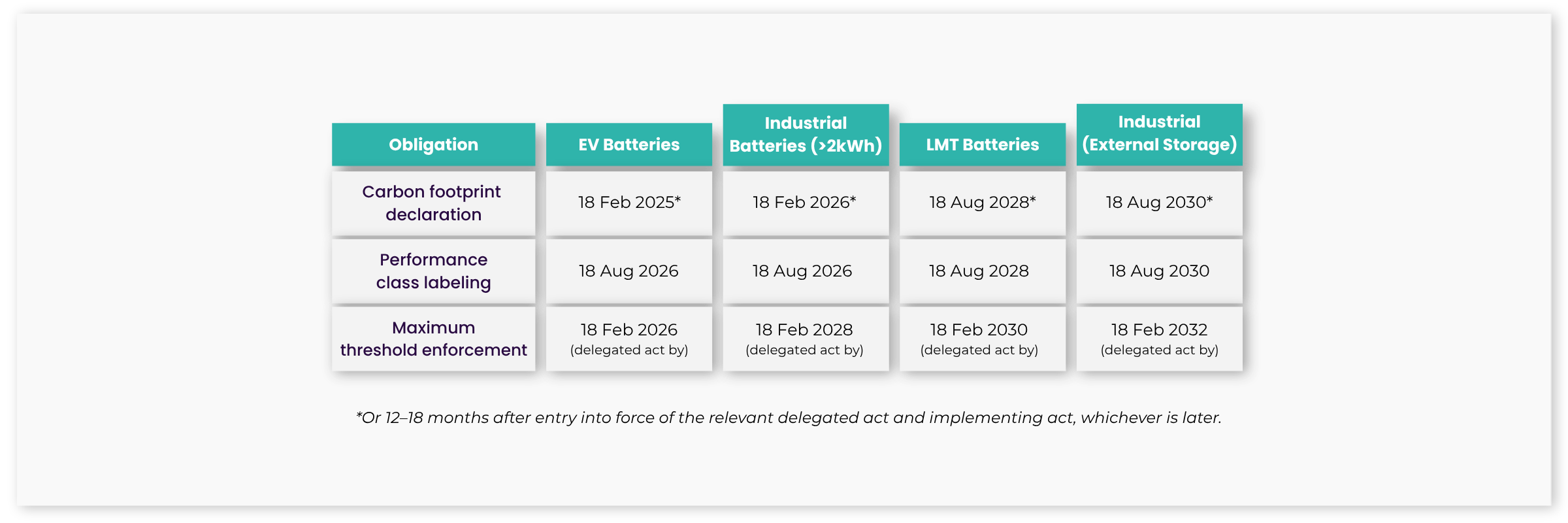
(Click on the image to enlarge it)
Important: The actual application date for carbon footprint declarations is tied to the publication of a delegated act (methodology) and an implementing act (declaration format) by the European Commission. Delays in adopting these secondary legislation acts push all downstream deadlines accordingly.
What the carbon footprint declaration must contain
A carbon footprint declaration is not a summary document, it is a structured technical output that must include:
- Administrative information about the manufacturer
- The total carbon footprint expressed as kg CO2e per kWh of total energy delivered over the battery’s service life
- A breakdown by lifecycle stage (see below)
- The identification number of the EU declaration of conformity
- A public web link giving access to the full study supporting the declared values
- The carbon footprint performance class, once those classes are in force
Importantly, carbon offsets must not be included in the declared footprint. They may be reported separately as supplementary environmental information, but they cannot reduce the figure submitted for compliance purposes.
The declaration must accompany the battery physically until 18 February 2027, after which it must be accessible via a QR code linked to the Digital Battery Passport.
The methodology: how the carbon footprint must be calculated
The regulation mandates the use of the Product Environmental Footprint (PEF) methodology, based on lifecycle assessment (LCA) principles consistent with ISO 14040/44 and ISO 14067.
The European Commission’s Joint Research Centre (JRC) has developed specific calculation rules for each battery type, first for EV batteries, then for industrial batteries (published April 2025), and currently in development for LMT batteries.
System boundary: what lifecycle stages are included
The calculation covers the battery’s entire lifecycle, excluding the use phase, following either a cradle-to-grave or cradle-to-cradle approach. The stages that must be accounted for are:
- Raw material extraction and processing: mining, refining, and processing of lithium, cobalt, nickel, natural graphite, and other materials
- Active material and cell manufacturing: production of the anode, cathode, electrolyte, separator, and cell casing
- Battery assembly: module and pack assembly at the manufacturing plant
- Distribution and transport: logistics from manufacturing to the point of sale
- End-of-life processing: recycling, recovery, and disposal
Data requirements: primary vs. secondary
One of the most operationally demanding aspects of the methodology is its data tiering:
- Primary (company-specific data) is mandatory for the main product production lifecycle stage, meaning site-specific, measured activity data for the manufacturing plant producing the battery. No default or industry-average data may be substituted for the anode, cathode, electrolyte, separator, and cell casing components.
- Secondary data (from third-party databases, industry averages, or proxy data) may be used for all other lifecycle stages.
Hence, this requirement forces manufacturers to have robust internal data collection systems across their production facilities. For example, a carbon footprint figure based on generic assumptions for the manufacturing stage will not be compliant.
Reference flow
The carbon footprint is expressed per a reference flow: kilograms of battery required to deliver one kWh of total energy over the battery’s service life. All activity data collected must relate to this reference flow, and the specific application of the battery (e.g., vehicle type for EV batteries) must be accounted for.
Third-party verification
A notified body must verify the declared carbon footprint as part of the battery’s conformity assessment. It cannot be self-certified.
The Digital Battery Passport: Where carbon footprint data lives
From 18 February 2027, all EV and industrial rechargeable batteries (>2kWh) placed on the EU market must carry a Digital Battery Passport, a QR-code-accessible digital record containing the battery’s carbon footprint declaration, performance class, recycled content data, electrochemical performance metrics, and traceability information. This is when carbon footprint data transitions from a paper-based compliance document into a living, digitally accessible record.
From 2028, the battery passport must also document the percentage of recovered (recycled) materials, cobalt, lead, lithium, and nickel, present in the finished battery, adding a second layer of supply chain traceability on top of the carbon data.
The compliance challenge: why this is harder than it looks
Many companies underestimate what Article 7 compliance actually demands at an operational level. Here is where the complexity concentrates:
Supply chain depth
Calculating carbon footprint accurately across raw material extraction, processing, and component manufacturing requires data from multiple tiers of the supply chain, data that most manufacturers do not currently collect or that their suppliers have never been asked to provide.
Site-level granularity
The declaration is per manufacturing plant, not per company. Therefore, a manufacturer operating three gigafactories must produce three separate declarations, each grounded in site-specific primary data.
Dynamic data management
As production processes, energy sources, or supply chains change, the carbon footprint declaration must be updated. This is not a one-time exercise.
Verification pressure
A notified body must independently verify the declared figures before they can accompany the battery to market. This creates a bottleneck if the underlying data and documentation are not organized well.
Battery Passport integration
Beginning in 2027, carbon footprint data needs to flow into a digital infrastructure, the battery passport, that connects manufacturers, importers, distributors, regulators, and recyclers. Consequently, companies without a traceable, structured data architecture will find this transition extremely difficult.
What needs to be in place and when
For companies still in the preparations phase, here is a practical view of what needs to happen:
Now (if you supply EV batteries or industrial batteries >2kWh):
- Map your supply chain at the level of detail required by the PEF methodology
- Establish primary data collection systems at each manufacturing plant, covering energy consumption, material inputs, and production volumes for battery-specific components
- Engage an LCA practitioner or accredited third party to begin the carbon footprint study
- Identify a notified body for verification
- Ensure your declared footprint can be classified against the carbon footprint performance classes once the Commission publishes the class definitions
- Prepare for labeling obligations. Accordingly, the battery label must contain a carbon footprint class
By 2027:
- Integrate carbon footprint data into your Digital Battery Passport infrastructure
- Ensure the data is accessible via QR code and structured in a format that supports role-based access and regulatory inspection
By 2028 onwards:
- LMT battery producers must begin their own LCA and declaration process
- Recycled content reporting adds a further data layer to the battery passport
Traceability is the foundation
The carbon footprint requirement is, at its core, a traceability requirement. Every kilogram of CO2 equivalent declared must be traceable back to an activity, a process, a supplier, a site, and a dataset. Consequently, every data point in the LCA study must be documented, auditable, and linkable to the battery model and manufacturing plant it describes.
This is where a robust traceability platform becomes the difference between compliance and exposure. Specifically, spreadsheets and email chains cannot sustain the data flows that Article 7 demands, not at the scale of a modern battery supply chain, and not under the scrutiny of a notified body verifying your declared values.
How can PSQR help
As a traceability software provider, we work with battery manufacturers, importers, and supply chain stakeholders to build the digital infrastructure required by Article 7 compliance. Our software, Saga, enables:
- Supplier data collection at the level of granularity required by the PEF methodology, per site, per component, per lifecycle stage
- Audit-ready documentation structured to support notified body verification
- Battery Passport integration, ensuring your carbon footprint data is ready to flow into your QR-accessible digital record from day one
- Ongoing data management, so that as your supply chain, energy sources, or production processes evolve, your declaration stays current
The regulation is not waiting. The methodology is increasingly finalized, delegated acts are being adopted, and notified bodies are beginning to process conformity assessments.
Therefore, companies that start building their data infrastructure now will be positioned to comply and to compete, as performance classes and thresholds begin to sort the market.
If your organization is working through what Article 7 means for your supply chain, we are ready to help you map the path from where you are today to full compliance.
This article is based on Regulation (EU) 2023/1542, the JRC’s published technical reports on carbon footprint methodology for EV and industrial batteries, and publicly available guidance from the European Commission and BatteryPass Ready consortium. Given the ongoing publication of delegated and implementing acts, companies should monitor official EU sources for the latest applicable dates and methodology requirements.