
Overview
In 2026, global supply chains have pivoted from passive tracking to active verifiability, catalyzed by the EU’s Digital Product Passport (DPP) and the Green Claims Directive. To maintain compliance and operational integrity, organizations are adopting interoperable standards like GS1 Digital Link and EPCIS 2.0 to provide legally auditable, unit-level data. This evolution transforms traceability into a strategic asset, enabling autonomous decision-making and circular economy functions such as reverse logistics. By moving beyond static reporting to dynamic, verified evidence, companies ensure regulatory alignment and meet the demand for high-integrity sustainability claims across borders.
Product verification is becoming the norm in 2026. As regulatory frameworks like the EU’s Digital Product Passport (DPP) and the Green Claims Directive reach full enforcement, the primary challenge for organizations has shifted. Now, it is no longer enough to simply know where a product is, companies must now provide an immutable, verified account of a product’s entire journey.
2026 represents the year of technical readiness. Navigating the complexities of multi-tier transparency and circular economy mandates will require more than just high-level oversight. It will require a robust, standards-native serialization engine. At PSQR, we see this as the move toward the true story of the product, where standardized data serves as the legal and operational foundation for every strategic decision.
Below, we explore the five pillars of supply chain traceability that are redefining the industry in 2026.
1. The Regulatory Deadline: From Pilot to Production for Digital Product Passports (DPP)
As we enter 2026, the era of voluntary sustainability reporting has officially ended. The EU’s Ecodesign for Sustainable Products Regulation (ESPR) is transitioning into its enforcement phase, making item-level traceability a mandatory license to operate in the European market.
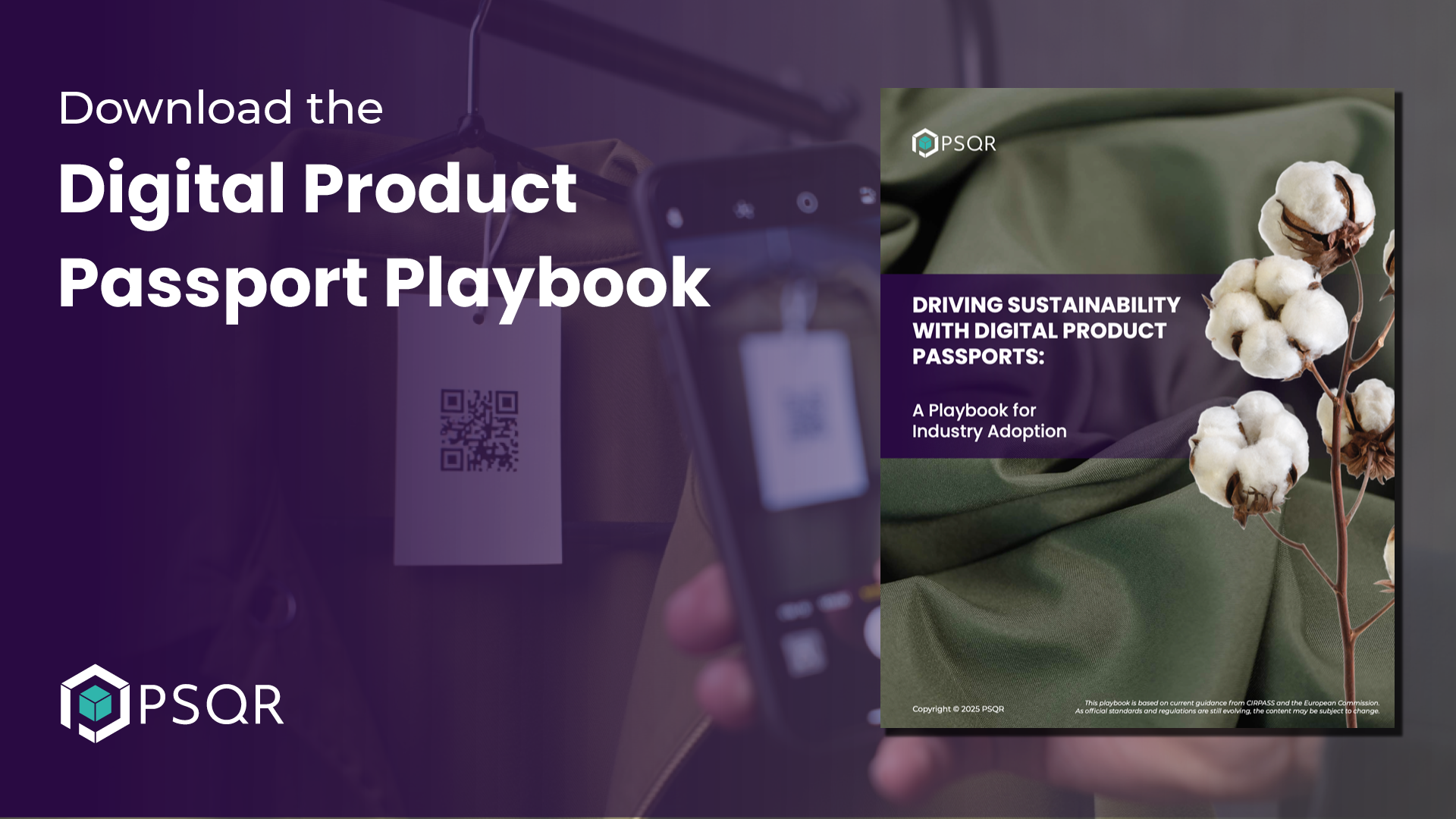
With the EU’s Digital Product Passports (DPP) regulation coming into force, companies in the battery, textile, and electronics sectors face a new reality: they must be able to provide a true story for every individual unit they place on the market.
Moving Beyond Static Compliance
In the past, compliance was often a reactive exercise involving static PDF audits and manual data entry. In 2026, the standard is shifting to dynamic data. A DPP will become a live digital twin that will require updates in real-time throughout the product’s lifecycle.
For the technical leadership, the challenge is no longer why to track, but how to manage the massive data volume of billions of unique IDs without compromising system performance. This is where PSQR’s Saga platform differentiates itself. We provide companies with high-performance serialization software that captures every event, from the point of origin to the final consumer.
Sector-Specific Impacts in 2026
- The Battery Traceability Roadmap: 2026 marks a dual-track requirement for battery manufacturers. First, labelling requirements for all batteries, including information on components and hazardous substances, become mandatory in 2026. Second, for industrial and EV batteries (>2kWh), companies must already be capturing and verifying the carbon footprint and recycled content (Lithium, Cobalt, Nickel, and Lead) to be ready for the February 2027 QR code and Battery Passport deadline.
- Textile & Apparel Preparation Phase: For the textile industry, 2026 is the definitive window for technical preparation. While the delegated act for textiles is expected by late 2026, the immediate priority is the EU ban on destroying unsold apparel, effective July 19, 2026, for large enterprises.
Phased DPP Rollout: Leading brands are utilizing 2026 to initiate pilot programs and integrate ERP/PLM systems. The goal is to be ready for the 2027-2028 Phase 1 mandate, which requires a minimal DPP covering material composition, origin, and care instructions. Leveraging our experience with industry leaders like RAINS, PSQR assists brands in establishing the system needed to bridge the gap between physical products and their digital history.

If you’d like to learn how PSQR can help your company, please fill out the form below and you will hear from our team shortly.
Transitioning from Compliance to Operational Value
Organizations adopting EPCIS-compliant architectures find that the same high-fidelity data used for the Digital Product Passport can be leveraged to automate customs documentation and streamline cross-border trade. At PSQR, we provide the technical foundation that ensures this data is accurate, immutable, and prepared for the digital transition.
2. Standardized Data Architecture: Ensuring Integrity in Global Information Exchange
In 2026, the primary technical hurdle for global supply chains is no longer data collection, but data liquidity. As companies are forced to share granular product information the industry is moving decisively toward open global standards. The era of siloed traceability systems is being replaced by interoperable architectures. These allow different software ecosystems to talk without friction.
The Migration to GS1 Digital Link
2026 marks a pivotal point in the “Sunrise 2027” transition, the global initiative to move from traditional 1D barcodes to 2D barcodes (such as QR codes) powered by the GS1 Digital Link.
- One Code, Infinite Uses: Unlike traditional barcodes, the GS1 Digital Link allows a single 2D carrier to serve multiple purposes: point-of-sale scanning, consumer engagement, and regulatory compliance (DPP).
- Technical Integration: At PSQR, we advocate for this transition because it simplifies the data layer. By using a standardized URL structure, the Digital Link connects the physical product directly to its digital twin in Saga. This ensures that a single scan provides the true story of the product across the entire value chain.
EPCIS 2.0: The Language of Supply Chain Events
To achieve true multi-tier transparency in 2026, the industry has converged on EPCIS 2.0 (Electronic Product Code Information Services). This standard provides the necessary framework to capture not just where a product is, but the context of what happened to it.
- Beyond Simple Tracking: EPCIS 2.0 allows the inclusion of sensor data (temperature, humidity) and certification credentials directly within the event record.
Standardized Collaboration: For PSQR, being standards-native is a core principle. By utilizing EPCIS 2.0, we ensure that data captured in a factory in Southeast Asia is usable by logistics providersin Europe and recyclers in North America. As a result, we areeliminating the need for costly custom integrations.
Traceability Architectures
The IT trends for 2026 are best-of-breed, modular solutions:
- API-First Strategy: PSQR’s architecture is built for this reality. Our software serves as a specialized traceability layer that integrates seamlessly into existing ERP, WMS, and MES systems via high-performance APIs.
- The End of Data Silos: This interoperable approach ensures that traceability data is no longer trapped in a single department but becomes a shared asset. Therefore, that drives value across the entire organization, from procurement to post-consumer recycling.
3. From Narrative to Evidence: Data Integrity as the Antidote to Greenwashing
In 2026, the era of aspirational sustainability messaging has effectively ended. As the EU Green Claims Directive and the Empowering Consumers for the Green Transition (EmpCo) Directive reach full enforcement by September 2026, the legal and reputational risks associated with unsubstantiated environmental claims have reached a critical level.
Hence, for organizations operating in the EU, sustainability is no longer a marketing narrative. From 2026, it is a data-anchored assertion that must be traceable, accurate, and independently verifiable.

The Enforcement of Substantive Proof
Under the EmpCo Directive, from September, it will be prohibited to use generic terms such as “eco-friendly,” “green,” or “carbon-neutral”. If used, they will have to be supported by recognized, high-performance environmental data.
- Beyond Offsetting: One of the most significant shifts is the restriction on climate neutrality claims based on carbon offsetting. Regulators will now demand proof of actual emissions reductions within the company’s own value chain.
The PSQR Perspective: We believe that integrity cannot be predicted, it must be recorded. By capturing granular event data at every stage of the product journey, PSQR’s software provides the evidentiary trail required to move to substantiated performance.
Human-Auditable Data in a World of AI
As supply chains become increasingly automated, a secondary trend has emerged in 2026: a demand for human-auditable ground truth. While AI can assist in analyzing patterns, it cannot serve as a legal witness to a product’s origin or its ethical conditions.
- Audit-Ready Documentation: The Corporate Sustainability Due Diligence Directive (CSDDD) now requires companies to not only identify risks but to demonstrate the specific actions taken to mitigate them.
Verified Origin: PSQR focuses on the technical verification of events. Whether it is proving the recycled content in a textile or the ethical sourcing of battery minerals, our platform ensures that the true story is backed by immutable digital records that can withstand the scrutiny of a third-party audit.
Building Trust through Technical Transparency
In 2026, consumer and stakeholder trust is built on access to raw, verified data. Companies are moving toward third-party certified labels and transparent data pathways.
- Evidence-Backed Commitments: Future-focused claims (such as 2030 Net Zero goals) are now legally prohibited unless accompanied by a publicly available implementation plan supported by real-time data milestones.
PSQR’s Role: Our architecture is designed to be the single source of truth. Thus, by providing a standardized, EPCIS-compliantrecord of every product movement and transformation, we empower brands to share their sustainability journey with absolute confidence, knowing every claim is rooted in technical reality.
4. Circular Economy Infrastructure: Traceability for Material Recovery and Reverse Logistics
In 2026, the strategic focus of supply chain management has expanded to include the entire post-consumer lifecycle of a product. Accordingly, driven by the framework of the EU Circular Economy Act,the priority for global organizations is establishing the technical infrastructure needed to facilitate repair, refurbishment, and high-value material recovery. Traceability serves as the foundational component of this shift. It provides the data necessary to manage used products as secondary raw material assets rather than waste.
A significant regulatory milestone occurs on May 21, 2026, with the full implementation of the Digital Waste Shipment System (Diwass). This platform mandates the electronic transmission of all documentation relating to waste movements between EU Member States, replacing legacy paper-based procedures.
For organizations managing reverse logistics, compliance in 2026 requires seamless integration with the Diwass platform to ensure authorized cross-border shipments of recyclables and end-of-life products.
Technical Requirements for Circular Compliance
To navigate the 2026 landscape, traceability systems must evolve from simple location tracking to comprehensive lifecycle management:
- Digital Waste Tracking: Under Diwass, companies must be prepared to submit electronic notifications and Annex VII “green list” information. This shall be done through standardized API integrations to avoid operational delays at borders.
- Access to Repair Data: With the national transposition of the Right to Repair Directive by July 31, 2026, manufacturers must ensure that technical specifications, repair manuals, and spare part compatibility are digitally accessible to third-party repairers.
- Material Grading: Achieving 2030 recycled content targets requires that 2026 systems can identify the precise chemical and material makeup of a product at its end-of-life, enabling automated sorting and high-purity recovery.
By maintaining a unique digital identity for each product, PSQR’s software acts as a secure repository for this data. Consequently,this allows brands to track repair histories and verify the authenticity of replacement components. In return, this directly supports the durability standards mandated by the ESPR.
Furthermore, the use of serialized identifiers allows organizations to automate the sorting of returned goods. This ensures materials are diverted to the most efficient recovery pathway, whether that be
- component harvesting,
- chemical recycling,
- mechanical processing,
ultimately improving the economic viability of the circular model.
5. High-Integrity Data as the Foundation for Autonomous Decision-Making
In 2026, the supply chain industry is moving beyond predictive analytics toward the deployment of autonomous agents. Unlike traditional automation that follows static, pre-defined rules, these agents can sense operational shifts, such as a logistics delay or a sudden capacity shortage, and proactively negotiate with partners or reallocate inventory.
However, the adoption of autonomous systems has highlighted a critical technical prerequisite: an agent is only as effective as the integrity of the data it consumes. PSQR views its traceability software as the essential ground truth layer. PSQR’s Saga ensures that the systems operate based on verified, real-time information rather than fragmented or unverified records.
Bridging the Gap Between Data and Action
The successful deployment of autonomous agents in 2026 depends on a unified data architecture. For an agent to autonomously reroute a shipment or adjust a production schedule, it must have access to item-level visibility that is standardized across the entire network. Without this foundation, the risk of automated error increases. For example, an agent may execute high-stakes actions based on data hallucinations or outdated information.
Standardized Signal Quality
To be agent-ready, data must be captured using global protocols like EPCIS 2.0. This ensures that when an autonomous system queries the status of a serialized product, the response is:
- Structurally consistent
- Machine-readable
- Legally auditable
The Verification Layer: While an agent handles the logic of a decision, PSQR’s software provides the verification. Therefore, we ensure that the events the agent relies on areimmutable and technically sound.
The Requirement for Human-Auditable Evidence
As autonomy scales throughout 2026, the demand for explainability has become both a regulatory and operational priority. If an autonomous system triggers a product recall or shifts a sourcing contract, organizations must be able to audit the rationale behind that action.
This is where the relationship between PSQR and autonomous systems becomes symbiotic.
Saga provides the digital ledger that records not only the physical movement of goods but also the specific data signals. This creates a permanent, human-auditable record of the product journey, even when that journey is managed by intelligent agents.
Hence, by focusing on data integrity at the source, PSQR allows companies to embrace the efficiencies of 2026 technology. At the same time, it allows the oversight and accountability required for a resilient supply chain.
Securing the Future with a Standards-Native Foundation
To sum up, as we look into 2026, it seems the divide in the supply chain space will be determined by data maturity. The move toward Digital Product Passports and autonomous decision-making isn’t a future possibility, it is an active requirement for market access and operational resilience.
Traceability has evolved from a siloed compliance task into a cross-functional strategic asset. Whether it is:
- ensuring the ethical sourcing of battery minerals,
- meeting the July 2026 ban on textile destruction,
- or providing the high-fidelity signals required for Agentic AI,
the common denominator is verified data integrity.
Finally, at PSQR, our mission remains focused on providing the technical infrastructure. Our Saga allows companies to capture this true story with absolute precision. By embracing open standards like EPCIS 2.0 and GS1 Digital Link today, organizations aren’t just meeting the mandates of 2026, they are building a resilient, transparent, and future-proof foundation for the decade to come.